Live on Solana Mainnet. Immutable.
Quantum Safe runs on Solana mainnet and holds real funds. The on-chain program verifies 34-chain SHA-256 Leighton-Micali One-Time Signatures (RFC 8554 LM-OTS) and is backed by an automated test suite. Nobody can change the program: its upgrade key was renounced, so it has zero administrative backdoors. Put in only what you can afford to lose.
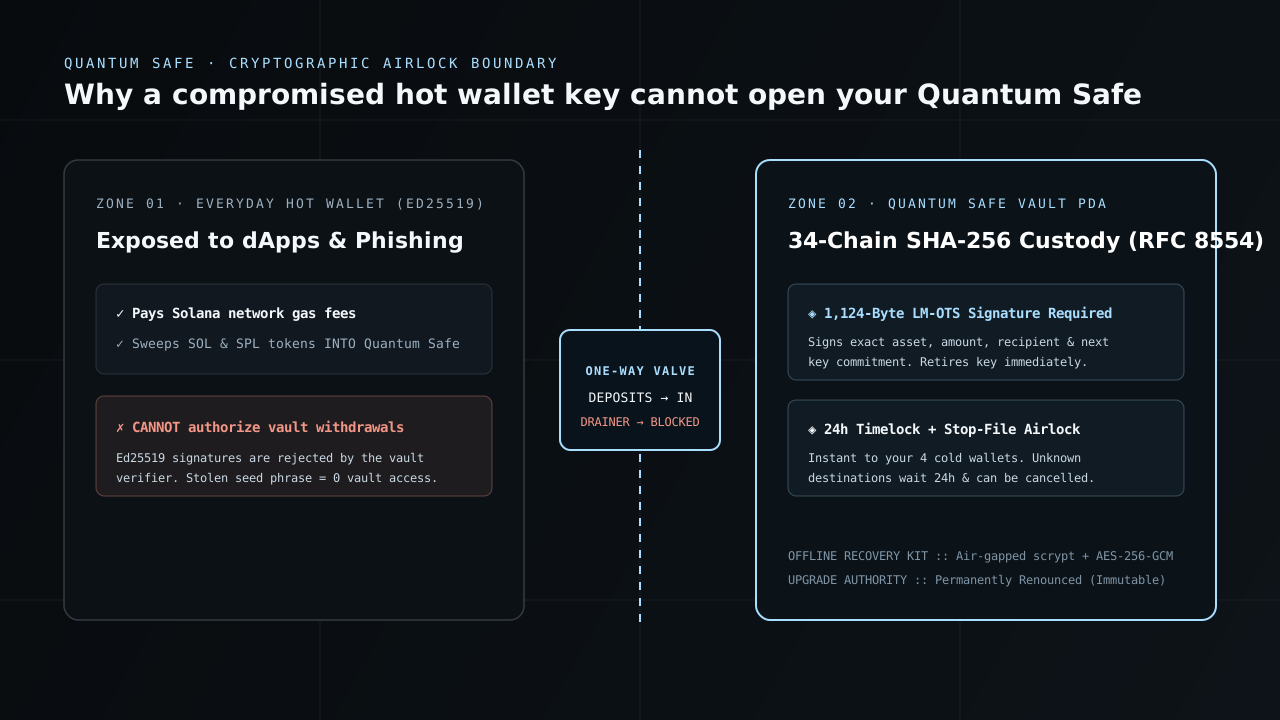
The intended security boundary
A connected Solana wallet funds a program-derived vault. To withdraw, the program verifies a separate hash-based one-time signature over the exact asset, amount and destination, and replaces the key in the same step. Possession of the wallet’s signing key alone does not satisfy that check.
This is a design objective supported by tests, not an external assessment of the complete product. The website, the offline tool, the deployment process and dependencies remain part of the attack surface.
Three secrets, and what each can do
- Your wallet key. Pays fees and deposits. Cannot withdraw from the vault.
- Your day key. Can announce withdrawals. A Quantum Safe is built with up to four trusted addresses and a waiting period for everything else. If the day key is stolen, the thief can send at once only to those trusted addresses, which are yours; a withdrawal to any other address waits, and you have that long to cancel it with your recovery kit. If you chose no waiting period, the thief can withdraw anywhere immediately.
- Your recovery kit. Can replace every key. Whoever holds it and its password controls the Quantum Safe. It is opened only in an offline tool, never on this website.
A published construction. An unreviewed integration.
The one-time signature is LM-OTS as specified in RFC 8554, section 4: 34 SHA-256 hash chains, a checksum, and a 1,124-byte signature. The verifier in the program and the signer in the browser were written from that text and are tested against the test vectors the RFC publishes: its signatures must verify, and signing with its private key must reproduce its signature.
Quantum Safe uses that one-time scheme on its own, with each signature naming the key that replaces it, not inside the LMS system the RFC mainly describes. That use, and two choices it involves, have not been examined by an outside cryptographer. Its security rests on SHA-256; the system as a whole is not quantum-resistant, because everything else on Solana still uses ordinary signatures.
What Quantum Safe does not protect
- A compromised browser or device. Malware, malicious extensions, injected scripts, or a compromised build can steal a day key opened on that device or alter a destination.
- A stolen day key with no waiting period. The offline tool starts on a 24-hour wait for any address you have not listed as trusted, and lets you turn the wait off. Without it there is no time to react. A trusted address is only as safe as the wallet behind it: list a hardware wallet, not the wallet you connect to websites.
- Loss of the recovery kit or its password. There is no reset and no administrator. A lost day key can be replaced only with the kit.
- One day key used on two devices. One device cannot know what the other has signed. Signing two different messages with the same one-time key makes forging a third practical. If that may have happened, install new keys with your recovery kit.
- A substituted recovery tool. The offline tool is downloaded from this site. Its published hash lets you check it; nothing forces you to.
- Solana as a whole. Consensus, transaction fee signatures, validator identities, RPC availability, and network cryptography remain outside this vault’s protection.
- Token issuers and authorities. Minting, freezing, or issuer controls are unchanged. A token can be frozen or lose value while held in a vault.
- A flaw that cannot be patched. The program’s upgrade key was renounced, so nobody can change its rules, and nobody can fix them either. A serious flaw would mean moving funds to a new program, which only works while withdrawals still do.
When something goes wrong
The app reserves a one-time key before signing with it and never signs a reserved key again. If a withdrawal is signed but never reaches the network, or a tab closes mid-way, that key is finished. The remedy is the same every time: in the offline tool, your recovery kit installs new keys. Your assets do not move.
A withdrawal that is waiting can be cancelled the same way. One that has been released cannot be undone.
Intentionally narrow asset support
SOL and ordinary accounts under the classic SPL Token program are supported in the test implementation. Token-2022 extensions, programmable NFTs, confidential transfers, swaps, bridges, arbitrary program execution, staking, and fee relayers are excluded. Vault account rent remains reserved.
Privacy and incident response
There is no advertising or analytics code in the app. Public wallet addresses and transactions go to the configured Solana RPC provider. A day key is handled in browser memory. If you save it with a passkey, an encrypted copy is kept in local browser storage, along with a record of which one-time keys this browser has used. The recovery kit is never handled by this site. JavaScript cannot guarantee erasure of all copies from memory.
Report vulnerabilities privately through GitHub private vulnerability reporting. There is no funded bounty, guaranteed response time, or named incident responder yet; those are release requirements. See the release requirements.